Threads were used to boost almost anything that got quick replies. And that included lazy posts like, What’s your favorite pizza?
So many users were unhappy about their feed being full of random questions and fake arguments.
Going into 2026, things are changing, a lot.
That means having interesting but relevant hooks, visuals that add to your post, and don't just stop people from scrolling.
You also need to post on a schedule and test different formats to see what works best.
This guide walks you through how to do that, using a step-by-step structure and tools like BlackTwist that help save you time and effort.
Try BlackTwist for free
4,000+ creators and small companies use BlackTwist to grow their audiences every month- What is engagement bait on Threads?
- How to tell if your Threads post is engagement bait
- Does engagement bait still work on Threads in 2026?
- What works better than engagement bait on Threads now
- How to turn your Threads engagement strategy into a system
- How to test engagement tactics without spamming people
- Related Reading
- Takeaways
What is engagement bait on Threads?
On Threads, engagement bait is any post that exists to trick people into quick likes, comments, or follows over providing real value.
Take a look at these common examples:
- Comment your age, and I’ll guess your job.
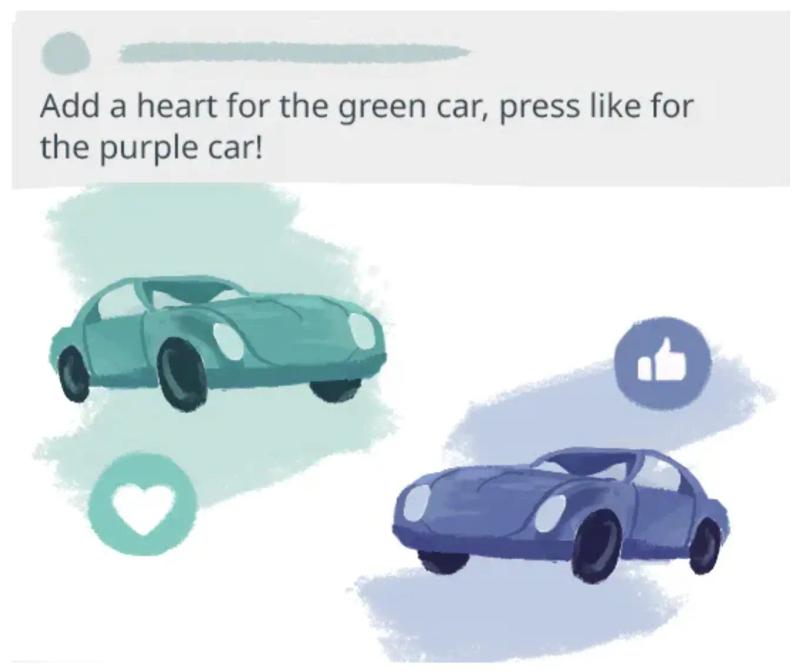
- Like this if you agree. Repost if you disagree.
- Random “this or that?” questions that don’t connect to your offer or your expertise.
Meta is increasingly penalizing obvious engagement bait and pushing posts that start real conversations.
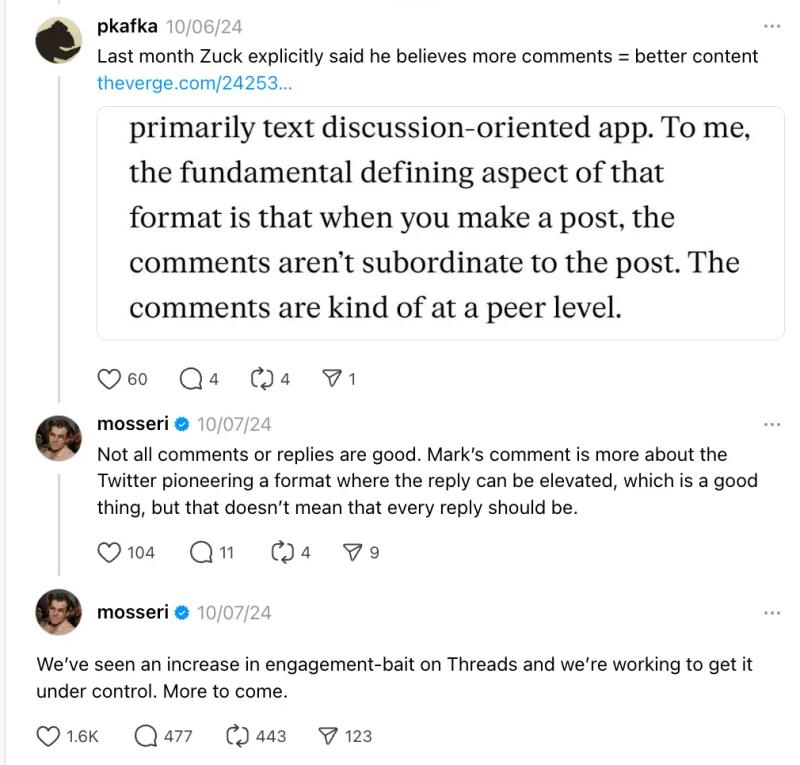
This attitude has been adopted since 2024. Take a look at this thread by Adam Mosseri, head of Instagram, who’s also in charge of Threads.
For any brand that has a content strategy and wants to build upon foundational engagement, that’s a win.
But, you still need to send strong enough signals that get the attention of your users as well as the algorithm.
The problem with this kind of content is that people might interact with it, but will not remember you or what you do.
They might even get offended after clicking on your post and discovering it was an empty promise.
What’s worse, it trains the Threads algorithm to see your account as low quality.
How to tell if your Threads post is engagement bait
Ask yourself three quick questions:
- Would this still be useful if nobody replied?
- Does this connect to my product, offer, or expertise?
- Would I respect a brand that posted this every day?
If your answer to any of these questions is no, your post is just random entertainment, not targeted brand marketing.
And trust that your audience will know that too.
Does engagement bait still work on Threads in 2026?
In the short term, engagement bait might still get some numbers. But are we talking long-term?
It usually hurts more than it helps.
Threads is pushing toward genuine replies and better post-to-account fit.
Obvious bait tricks like “comment to get the guide” still work, but they are more likely to get pushed down over time.
Also, low-quality engagement can hardly turn into pipeline, demos, or revenue.
What works better than engagement bait on Threads now
Focus on posts that actually help people and show what you do.
Say something like, Here’s why your current approach is wasting budget. Then, go on explaining what you did wrong and what you learned to do instead.
If you can provide a process breakdown, it often resonates with people. For example, share your step-by-step on how we turned 37 comments into four sales calls.
Tell them your process in clear steps, and if someone asks in the comments, add more details.In addition to creating strong branding, this type of conversation gives you more to work with as idea seeds for your future posts.
How to turn your Threads engagement strategy into a system
Have an on-the-go approach.
If you don't want to forget your ideas (the information overload is real for all of us), you can create a system to write them down and schedule them as you go.
Use handy tools like BlackTwist’s mobile app to write, draft, schedule, and even repurpose your high-performing content on your phone with minimum overhead.
It’s free for beginners (you can scale later), and it's easy to download and install: here’s how.
Topic coverage from start to end
Inside BlackTwist, you can save the structure of a post you like, including the headline formula, slide flow, and prompts.
Next time, you can copy that structure, switch to a new topic (tool stack, onboarding, ad spend, etc.), update the details, and schedule it.
Always remember to use Analytics to see which topics actually drive profile visits, saves, and follows
Now you’re not staring at a blank screen thinking, What do I post on Threads today? Instead, you’re reusing proven formats and making them better.
Generating Carousels (free)
With BlackTwist’s Carousel Generator, you can:
- Turn your idea into a swipeable, one-word-per-slide text carousel in a few minutes.
- Help people get inspired by your posts and quickly reshare them with their team.
Create a posting schedule
Random posting brings random results. You need a simple system you can stick to.
Instead of scheduling every post by hand, create preset time slots in BlackTwist. Then you just drop posts into those slots, and BlackTwist auto-publishes them.
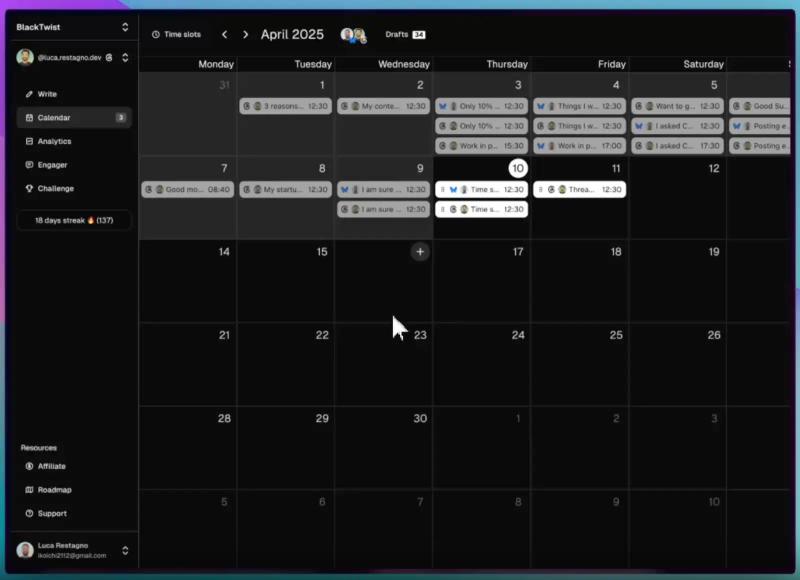
You stay consistent without living inside your calendar.
Analyze your performance on a routine basis
Make sure that once a week, you open BlackTwist Analytics and:
- Filter by tag (like “case study”, “hot take”, “carousel”)
- Sort by saves, replies, or profile visits
- Export a CSV if you want to dig deeper or share results with your team
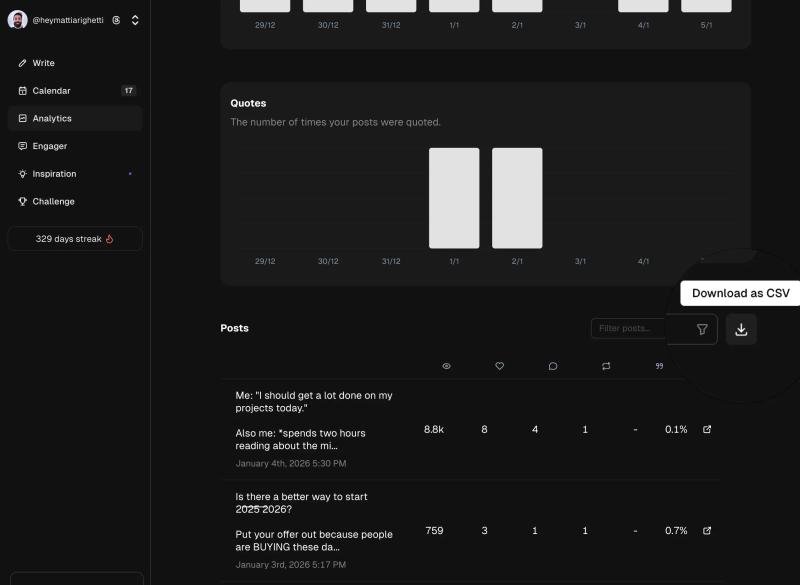
Are you going to share more of what worked and less of what didn’t? Don't skip the analytics. Doing just this already puts you ahead of most brands on Threads.
How to test engagement tactics without spamming people
So which hooks work on Threads?
Start with ten ideas to post on Threads. From those, choose one and post two variations (apart) each week for three weeks.
Do this in BlackTwist to rework the same idea from new angles.
Then watch the data. Tag each post by format (story, list, opinion) and by goal (followers, leads, awareness).
In Analytics, you don’t just see “good” or “bad.” You see what type of post actually gets replies or and profile visits.
When something works, keep it in a separate tab.
Then, when you need it (and it fits your strategy), open the high-performing post, tweak the hook or examples, and schedule it again later.
This way, you’re not spamming your audience. You’re improving one strong idea over time. That’s how you grow with signals that moves the platform’s ranking system.
Related Reading
- Threads Monetization Requirements 2026
- How to Make a Threads Account
- How to Turn Your Content into Income on Threads
- Using Threads for Small Business
- How to Make a Threads Account
Takeaways
Like any other corner of the internet, engagement bait is dying out. Repeatable systems that are built on real value are taking over and are here to stay.
Throughout 2026, Threads will continue to reward brands that show up consistently, share real proof (numbers, case studies, lessons), and have genuine conversations with the right people.
Of course, given that your account sticks to the platform’s branding guidelines.
You can use BlackTwist’s free plan to practice this: set your posting rhythm, tag your posts, review what works weekly, and slowly turn Threads into a system.